The Rules of Knightly Contests “a New Hope“
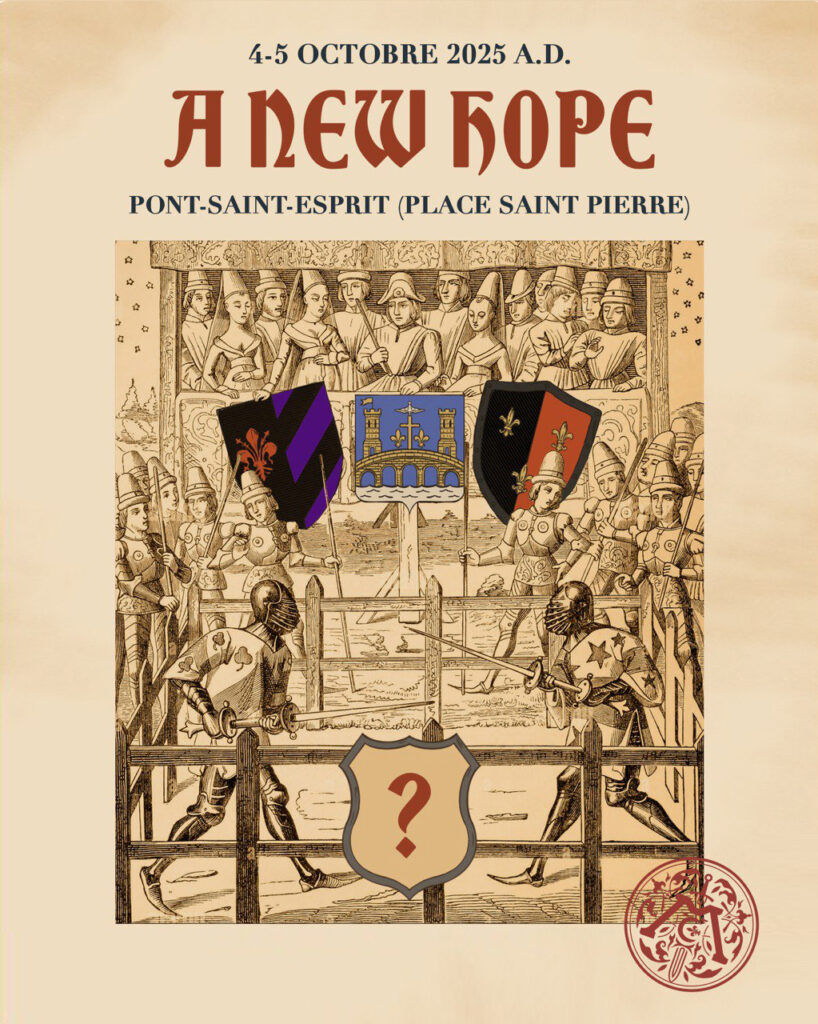
Chapter One. Where and when the contests shall be held
A glorious tournament shall be held in the lands of Occitania, near the city of Saint-Chaptes, in the year of Our Lord 2025, on the fourth and fifth days of October.
Chapter Two. On who may be admitted to the contests
The mighty lord, Raymond, Count of Toulouse, proclaims that all who wish to display their valor may come to the lists.
Let neither birth nor vassal oath, nor service in any order restrain a warrior from entering.
Knights, squires, pages, and warriors of humble rank may contend — yet none under eighteen years of age shall take the field.
Chapter Three. On fair judges
Let each retinue or company choose from among their number one noble warrior of unimpeachable honor, who shall swear to act as judge.
These judges shall observe the contests, call out those who act unworthily, and point them to the heralds, that they may receive just punishment.
The lordly Count of Toulouse shall appoint his herald as tournament master, aiding the judges in all matters.
Chapter Four. On arms, armor, and appearance
Each warrior shall come equipped for melee, with armor and weapons fit and free from shameful rust or dents.
Over his harness he shall wear a tabard bearing his own arms or those of his retinue or lord, and all of one company shall wear matching colors.
Let those who take the field appear with dignity, for slovenly warriors shall be disgraced and cast out.
Chapter Five. On the contests themselves
• Article One. On the field of honor
All battles shall be fought upon trampled ground, fenced no higher than a man’s waist, as was the custom of old.
• Article Two. On the battles of knights
Knights shall gather in companies of seven, fighting in full harness beneath a single leader and banner.
Victory shall belong to the party that defeats its foes three times in succession.
Let the Code of the Order of Magna Carta be the rule and measure of conduct.
• Article Three. On the battles of chivalrous ladies
Let noble ladies of knightly spirit gather in companies of five, likewise fighting as in the bugurt, in tabards of one banner and arms.
Here too the Code of Magna Carta shall prevail.
• Article Four. On the Italian contest called “Battle on the Bridge”
All — knights, squires, pages, and common fighters alike — are called to test themselves in this game of arms, armed not with noble steel but with hard wooden staves.
The heralds shall declare the manner of this contest.
• Article Five. On the great melee in the ancient spirit
The Count of Toulouse and Lord Medici, on behalf of the knights of the South, issue their challenge to the knights of the North: to meet them in a melee of 21 against 21, as in the battles of old.
This contest too shall be held under the Code of Magna Carta.
• Article Six. On the battles of Sunday
On Sunday, after Mass, let those who wish to prove themselves in single combat issue their challenges and fight with such weapons as they choose, to the honor and entertainment of all.
Chapter Six. On rewards and honors
Let the victor of the tournament be glorified and richly rewarded.
All participants shall receive tokens of remembrance, and the finest knight shall be admitted into the Order of Magna Carta.
Chapter Seven. On the glorious feast
And when the contests are done, let the warriors gather at a mighty feast, where each may eat of the meat and drink of the ale as much as his stomach can bear.
⚔️ Thus is proclaimed the Rule of the Tournament “New Hope.” ⚔️
